Everyone Needs A Barnabas, A Paul, And A Timothy
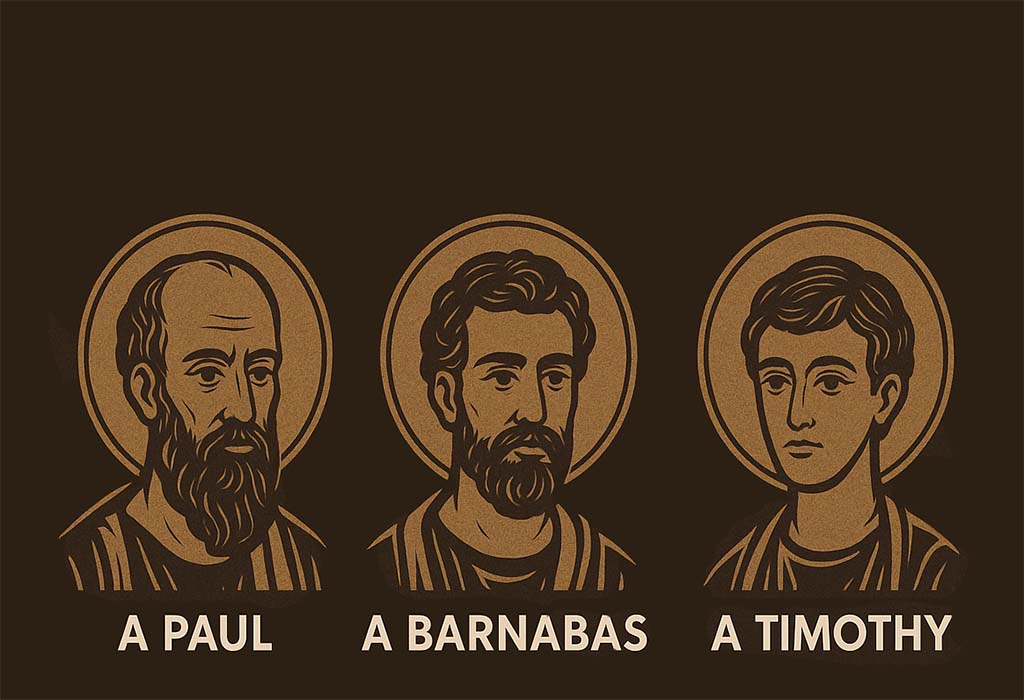
Everyone Needs A Paul, A Barnabas, And A Timothy
Part One: Barnabas
Acts 4:36-37: Joseph, a Levite from Cyprus,
whom the apostles called Barnabas
(which means “son of encouragement”),
sold a field he owned
and brought the money and
put it at the apostles’ feet.
Everyone Needs A Barnabas
Everyone needs a Barnabas,
a loving and faithful believer
who joyfully serves our Lord Jesus
while encouraging, teaching,
believing, inspiring, caring,
challenging and building
your faith in the Master
as you become His Disciple.
Even the great Apostle Paul
needed His brother in the Lord, His
fellow Apostle in Antioch,
His missionary companion
living in the midst of travels,
travails, welcoming new
believers, establishing
churches, facing persecution. . .
. . .Challenging each other to stand
on the Word, even in declaring
God’s Truth, pointing together
the Church to faith in Jesus over
works of the Law—remaining
true to the Gospel to defend
Gentile believers in Antioch
before the leaders in Jerusalem . . .
We all need a Savior, indeed. What a wonderful Savior we have in Jesus. He loves us. He calls us. He welcomes us. He redeems us. He leads us. He prepares us. He takes us home to Heaven. We will spend eternity expressing our gratitude forall He does.
He does not leave us alone. He surrounds us with His own people, gifted and equipped and called to walk alongside us in the mystery of growing in Him toward maturity in His Kingdom of Love and Light and Life. Bible teachers often express this by saying we (as believers) need a Paul, a Barnabas and a Timothy.
I am going to rearrange that order, beginning with Barnabas, rather than Paul, and finally Timothy. While we all definitely need a Paul, I believe we would never find our own Paul, for they are rare, indeed; if there were no “Barnabas-es” to provide fellowship, encouragement, support, and camaraderie. I am reminded of the new believer, Saul, who had terrorized the church in Jerusalem and beyond—in many ways making himself their chief persecutor. Then, after Jesus literally blinded him with conviction, and he came to belief in Damascus, Saul needed someone to stand up for him among the Disciples in Jerusalem, Barnabas did stand up for him. And when Barnabas needed a co-laborer in Antioch, he went and found Saul in Tarsus. Surely he was sent by the Holy Spirit on a divine mission to bring into ministry Saul who would become the mighty Apostle Paul.
Because Paul’s redemption had been so startling, the church leaders in Jerusalem found it difficult to believe that their greatest persecutor had now become a sincere believer, himself. So, we read in Acts 9:27; Then Barnabas brought him to the apostles and described how Saul had seen the Lord, who spoke to him on the road to Damascus, and how Saul had spoken boldly in that city in the name of Jesus. Barnabas put his good reputation on the line to stand up for Saul and the genuineness of his faith in Jesus.
Acts 11: 25-26: So Barnabas went to Tarsus to look for Saul, and when he found him, he brought him to Antioch. For a whole year they met with the church and taught a great many people. And in Antioch the disciples were first called Christians. Later, as Barnabas worked with the church in Antioch, he realized he needed a co-leader, so he went to find Saul in Tarsus. He brought him back, and they led the work together as God did amazing work using the two of them in seeing many called into ministry through the church where believers were first called Christians. In Acts 11 and 12 we read that Barnabas and Saul were sent with gifts to help feed the believers in Judea during a time of famine. Then they returned to Antioch together, with John Mark, thought to be a cousin of Barnabas.
Acts 13:1-4: Now there were in the church at Antioch prophets and teachers, Barnabas, Simeon who was called Niger, Lucius of Cyrene, Manaen a lifelong friend of Herod the tetrarch, and Saul. While they were worshiping the Lord and fasting, the Holy Spirit said, “Set apart for me Barnabas and Saul for the work to which I have called them.” Then after fasting and praying they laid their hands on them and sent them off. So, being sent out by the Holy Spirit, they went down to Seluecia, and from there they sailed to Cyprus. So, amongst the prophets ministering in the Antioch church, the Holy Spirit called two of them to become missionaries in Cyprus and beyond. Interestingly it seems that as they began their work, Barnabas was the leader, but as they moved more and more into the Gentile world, Saul was called by his gentile name, Paul, and assumed more and more of the leadership role. Yet, they worked as a team, along with Mark, who accompanied them. Those who take the Gospel around the world today still find that pairs of missionaries generally do better than those who work alone.
I know I have certainly been blessed to have “Barnabas-es” supporting, encouraging, correcting and pushing me to fulfill the Call of God in my life. I think of Marsha Eichenberg Cooke, who mentored me through four years of summer missions. Something like a Drill Instructor, she taught me how faith acts through the Grace of God in the midst of troubling circumstances. Next Norman and Carolyn Mock in Ludowici Georgia, two of the “loving-est” folks I have ever known, helped me grow up as I lived and taught and served alone for the first time. In Nigeria one of my first discipleship group members, Mike Tosan, taught me how deep, deep faith can overcome all obstacles, and bear fruit for God. And then as Becky later joined me there, Don and Gwen Reece both loved and challenged us to see how far God would take us in serving Him. In Niger an eighty year-old volunteer who deeply loved God’s Word, Jim Kelly, taught me so much about the faithfulness of God. Each of these, in his or her own way, did what Barnabas did for Paul—they modeled for me how we can and must depend on God as He calls us into and develops us for His service.
Even as God the Father, Son and Spirit, exhibit so beautiful a manifestation of His Oneness in dynamic Love of our great God; even so, we never stand alone in our worship and service to our Maker. Each of us is but one within the Body, the Church; and so we deeply depend on each other as we grow in knowledge, in fellowship, and in service to our Maker, Savior, Spirit—three-in-one.
 imunify-bot-check