JESUS:KEEP GOING!
JESUS:KEEP GOING!!!
Last week we looked at the twelve disciples who lived out their deep, heart-felt commitment to obey Jesus’s Great Commission. The Holy Spirit led and empowered them as they visited countries throughout much of the known world. They preached the Gospel, healed people, and established local churches. They taught people everywhere about Jesus, His Life and His Word. They gave themselves fully to obey their Lord wherever He led them. We believe from early church history that they all died as martyrs, except for John, who lived his long life, dying in Ephesus after his exile on Patmos. Interestingly, the disciples traveled amost continuously, even as far as India, where early. church history says Thomas ministered and died.
During times of famine and persecution Jewish leadership in Jerusalem violently opposed the Apostles and the early church. One of their strongest persecutors, Saul of Tarsus, met Jesus on the road to Damascus. That meeting changed his life and the life of the church forever. God’s Work in him led to his becoming the Apostle Paul. He eventually took three missionary journeys, which God used to establish strong and growing churches throughout modern Greece and Turkey. His work concluded in Rome, where he gave his life as a martyr for His beloved world.
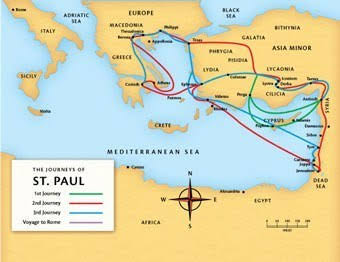
FIRST MISSIONARY JOURNEY:
Antioch in Syria, Cyprus (Salamis and Paphos,)
Modern Turkey (Perga, Pisisidian Antioch, Iconium, Lystra, and Derbe
Attalia
SECOND MISSIONARY JOURNEY:
Antioch in Syria, Syria, Cilicia, Phrygia, Galatia (Visiting Lystra and Derbe Again,
Macedonia and Greece (Entering Europe)
Troas, Samothrace, Neapolitan, Philippi, Thessalonica,
Berea, Athens, Corinth
Cenchrea, Ephesus, Caesarea, Jerusalem, Antioch
THIRD MISSIONARY JOURNEY
Antioch in Syria, Galatia, Phrygia, Ephesus
Macedonia and Greece, (Achaia)
Journey to Jerusalem, Assos, Mitylene, Chios, Samos, Miletus, Cos,
Rhodes, Patara, Tyre, Ptolemaic, Caesarea, Jerusalem
FINAL VOYAGE TO ROME
Sidon, Myra, Fair Havens, Malta, Syracuse, Rhegium, Puteoli, Rome
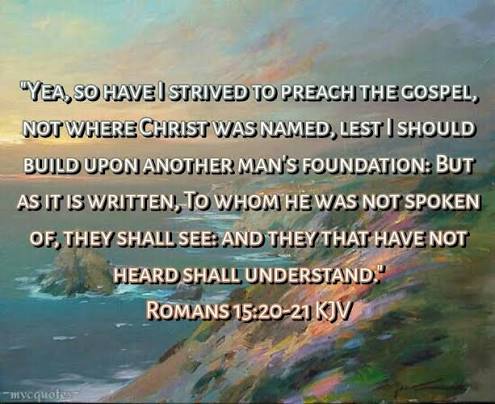
Paul clearly understood his calling as a missionary assignment to spread the Gospel wherever God led Him. In doing so He purposefully trained leaders who led the churches and trained others to continue making disciples. These included Timothy, Titus, Epaphras, Silas, Aquila and Priscilla, Tychyus, and Luke. Paul clearly expected even new believers and new churches to pray, to give toward fulfilling the needs of God’s people, and to go as God called them, some to evangelize and disciple in their own hometowns and regions, and some to follow God’s call to travel where the Gospel had never been heard before.
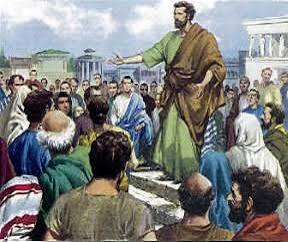
Acts 17: 22-32
22 So Paul, standing before the council, addressed them as follows:
“Men of Athens, I notice that you are very religious in every way,
23 for as I was walking along I saw your many shrines.
And one of your altars had this inscription on it: ‘To an Unknown God.’
This God, whom you worship without knowing, is the one I’m telling you about.
24 “He is the God who made the world and everything in it.
Since he is Lord of heaven and earth, he doesn’t live in man-made temples,
25 and human hands can’t serve his needs—for he has no needs.
He himself gives life and breath to everything, and he satisfies every need.
26 From one man he created all the nations throughout the whole earth.
He decided beforehand when they should rise and fall, and he determined their boundaries.
27 “His purpose was for the nations to seek after God
and perhaps feel their way toward him and find him—though he is not far from any one of us.
28 For in him we live and move and exist. As some of your own poets have said,
‘We are his offspring.’
29 And since this is true, we shouldn’t think of God
as an idol designed by craftsmen from gold or silver or stone.
30 “God overlooked people’s ignorance about these things in earlier times, but now he commands everyone everywhere to repent of their sins and turn to him.
31 For he has set a day for judging the world with justice by the man he has appointed,
and he proved to everyone who this is by raising him from the dead.”
32 When they heard Paul speak about the resurrection of the dead,
some laughed in contempt, but others said, “We want to hear more about this later.”
Wherever He preached, Paul clearly explained the Gospel in terms the local people could understand. He clearly presented Jesus as the One who could save all people everywhere. He clearly respected the people for who they were, so He did not speak down to them, but He challenged them to find in Jesus the One their hearts and minds had been searching for.
This is the point: Without the Great Commission and how faithfully the original Apostles, and the Apostle Paul, and countless other early Christians lived and died to fulfill Jesus’ commandment to take the Gospel to the whole world, we would be lost today. We must continue just as faithfully praying, giving and spreading the Gospel until those near, far, and farther still have had their chance to hear the Great Good News of Jesus as the One who can reconcile them to our great God of Love.